I’m an electronics developer and re/habilitation assistive technology innovator with a background spanning systems engineering, programming, embedded electronics, sensor technology and technical development.

My technical background began in systems engineering and software development, before evolving into the hands-on development of assistive technology.

For almost two decades, I’ve applied that technical experience to assistive technology, biomechanics, human movement and re/habilitation — identifying individual needs and designing and building custom sensor systems, biofeedback technologies and physical prototypes for our son Julian. My development work incorporates IMUs, pressure sensors, EMG, embedded microcontrollers, real-time data processing, C++, C#, Python and Unity.

Today, that combination of electronics, software, biomechanics, VR, fabrication and systems engineering — together with nearly two decades of practical, person-centred problem-solving — underpins my approach to assistive technology: understanding individual needs, overcoming challenges and using technology to help people achieve greater independence.

Today after 17 years, Julian has grown into an independent young man and no longer needs the same level of support from me. That gives me the opportunity to focus my energy, experience and skills in a new direction to help others and I’m ready to take that experience into the next chapter of my career.

Here are some of the things I’ve done…
WEIGHTBEARING PLATFORM & LASER GUN

An interactive re/habilitation system that combines balance training with a wirelessly controlled laser-target game.

What it is:

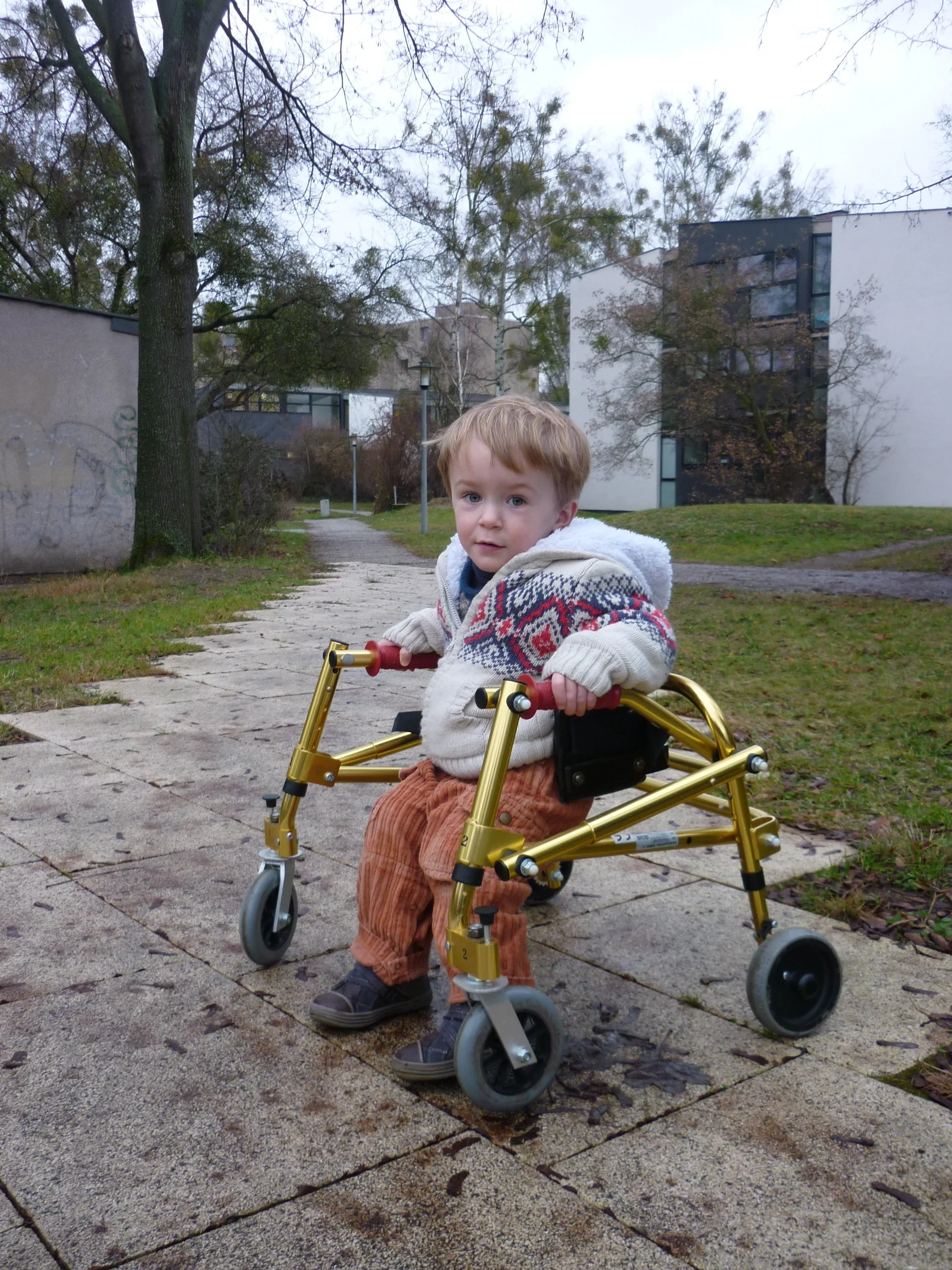
At around three years of age, Julian consistently bore almost all of his weight through his right leg. His reduced trunk stability made it impossible for me to provide the continuous upper-body postural support and corrections required while simultaneously monitoring his symmetrical weight-bearing.

Why I built it:

Maintaining symmetrical weight-bearing during balance training is repetitive, difficult to sustain, and often lacks meaningful motivation.

The Problem:

The pressure-sensitive platform continuously monitors bilateral weight distribution using eight plantar force sensors. Only when the user maintains adequate weight-bearing symmetry does it wirelessly activate the laser gun, rewarding correct posture with the ability to shoot.

The custom-built laser gun incorporates multiple safety systems, including motion detection, ultrasonic target verification and accelerometer-based orientation monitoring, ensuring the laser is active only when it is safely aimed at the target. Hits are detected electronically and scored in real time.

Although the task proved too demanding as a habilitation exercise for Julian, the project demonstrated how immersive, game-based biofeedback can transform repetitive therapy into engaging, motivating training.

MARBLE RUN

The Marble Run is a gamified re/habilitation system that transforms balance training into an interactive reward-based activity.

What it is:

Julian found the laser gun and platform too demanding as it required simultaneous upper-limb motor control and postural stability, resulting in everything being just too much to handle. But he liked the platform itself…which was good because it was the essential part of the marble run system.

Why I built it:

Poor engagement during repetitive balance training reduces motivation and re/habilitation outcomes.

The Problem:

Using the same wireless weight-bearing platform developed for the Laser Gun system, marbles are released only when the user maintains symmetrical weight distribution. As the marbles travel through the eight-level course, points are awarded for correct posture. Loss of balance opens servo-controlled escape gates, causing the marbles to fall out of the run and deducting points.

Unlike the Laser Gun, the Marble Run requires no additional cognitive/physical tasks, allowing users to focus entirely on posture. The result is a simple, engaging therapy system that proved far more motivating and enjoyable for long-term habilitation for Julian.

J-SHOES

J-Shoes is a wearable biofeedback system that monitors bilateral plantar pressure to promote symmetrical weight-bearing.

What it is:

Julian loved the Weight-Bearing Platform and Marble Run, but they were fixed in one spot. I wanted the same level of engagement while allowing unrestricted movement during his physio work.

Why I built it:

Poor weight-bearing symmetry during standing and walking.

The Problem:

Each shoe contains four pressure sensors and an Arduino Micro. The right shoe receives data from the left, compares corresponding forefoot and heel pressures, and triggers vibrotactile feedback when imbalance exceeds a user-defined threshold for a specified duration.

An Android app communicates with the shoes via Bluetooth, displaying real-time pressure data while allowing adjustment of sensitivity and feedback timing.

Although the concept was successfully demonstrated, Bluetooth latency, limited processing power and a basic 2D interface restricted its fun-using potential.

J-Shoes ultimately served as the proof-of-concept that evolved into the more advanced ARGait.

ARGait

An augmented reality gait system providing real-time 3D visual feedback of foot movement and placement during walking.

What it is:

Julian could not visualise or correct his foot position during gait training without constant verbal supervision or the use of a mirror.

Why I built it:

Julian lacked the proprioceptive and visual feedback needed to recognise and correct his gait pattern or foot strike.

The Problem:

ARGait is an augmented reality gait re/habilitation system that provides real-time 3D visualisation of foot kinematics. Virtual feet are overlaid onto a live smartphone camera feed, allowing users to monitor and immediately correct foot placement during walking without mirrors or external visual cues.

Sensor fusion combines a Time-of-Flight sensor (VL53L1X), BNO055 IMU, magnetometer and four plantar pressure sensors per foot. Data are processed by a Teensy 4.1 microcontroller and rendered in Unity.

The system operates in two modes:

* Gait Mode: Real-time 3D foot tracking with swing-phase timing. * Standing Mode: Bilateral plantar pressure comparison for weight-bearing symmetry.

TipToeTracker

A wearable biofeedback device slipped into the sock that detects toe-walking and provides vibration and audio cues to promote heel contact.

What it is:

When standing still, Julian bore almost all of his weight through one leg while remaining on tiptoe with the other.

Why I built it:

Persistent toe-walking often occurs unconsciously throughout the day, making it difficult to correct consistently without continuous feedback.

The Problem:

TipToeTracker is a compact wearable biofeedback device designed to reduce persistent toe-walking. Worn inside the sock at calf level, it continuously monitors lower-leg angle using an inertial sensor. When prolonged plantarflexion is detected, the device delivers progressively stronger vibrotactile feedback followed by an audible alert, encouraging the user to return the heel to the ground.

Measuring just 44 × 31 × 10 mm, the device is powered by two coin-cell batteries.

Julian wore it every day for several years.

FINGER TRAINER

A gamified re/habilitation device designed to improve finger strength, coordination and independent motor control.

What it is:

Julian wanted to learn the piano, but impaired fine motor function and reduced independent finger control limited his ability to form chords.

Why I built it:

Restoring finger strength, coordination and independent finger control requires repetitive exercises that often provide little feedback or engagement.

The Problem:

Five pressure-sensitive finger pads measure individual finger force, with each sensor driving a dedicated strip of programmable NeoPixel LEDs. The harder the user presses, the more LEDs illuminate, providing immediate visual biofeedback.

The system can present programmable finger-strength and coordination challenges, encouraging users to reproduce specific force levels and finger combinations while scoring their performance.

Although the prototype demonstrated the concept successfully, future versions will replace the rigid tube assembly with a wearable glove, providing greater comfort, accuracy and freedom of movement.

LASER BALANCING

A training tool that promotes symmetrical weight-bearing with engaging visual-motor training.

What it is:

Julian found it difficult to maintain a stable standing position, relying on continuous lateral weight shifting to maintain balance.

Why I built it:

Balance and postural control exercises often fail to integrate visual-motor coordination while providing real-time feedback on weight-bearing symmetry.

The Problem:

A lightweight laser module is secured to the user’s chest using a Velcro strip. While standing the user directs the laser at designated wall targets.

Difficulty can be progressively increased by varying target size, distance, sequence and timing, or by adding cognitive tasks such as counting, colours or numbers. The system provides an inexpensive and effective way to combine balance, trunk control, and visual tracking.

DORSIFLEXOR

A controlled passive stretching device designed to safely increase ankle dorsiflexion.

What it is:

As Julian grew, passive dorsiflexion could no longer be achieved using his body weight alone, and my manual stretching through pelvic loading became increasingly difficult.

Why I built it:

Individuals with high muscle tone often cannot generate sufficient body weight or maintain a controlled stretch to improve ankle dorsiflexion safely and effectively.

The Problem:

A linear actuator applies a precisely controlled force to a wedge beneath the footplate, producing a passive stretch of the gastrocnemius, soleus and associated fascia. The wedge mechanically limits the maximum dorsiflexion angle, ensuring the foot cannot be stretched beyond the prescribed range, making the device completely safe.

The actuator is controlled by a microcontroller and offers both manual and automated modes. Manual controls allow precise positioning, while a randomised mode continuously varies the stretch angle to produce gentle, dynamic dorsiflexion changes. Actuator position is monitored using a distance sensor to provide accurate and repeatable movement.

The concept demonstrated excellent potential, particularly for individuals with high muscle tone who are unable to generate sufficient body weight for effective stretching. Future versions will improve the mechanical stability of the actuator assembly under higher loads.

Get in Touch